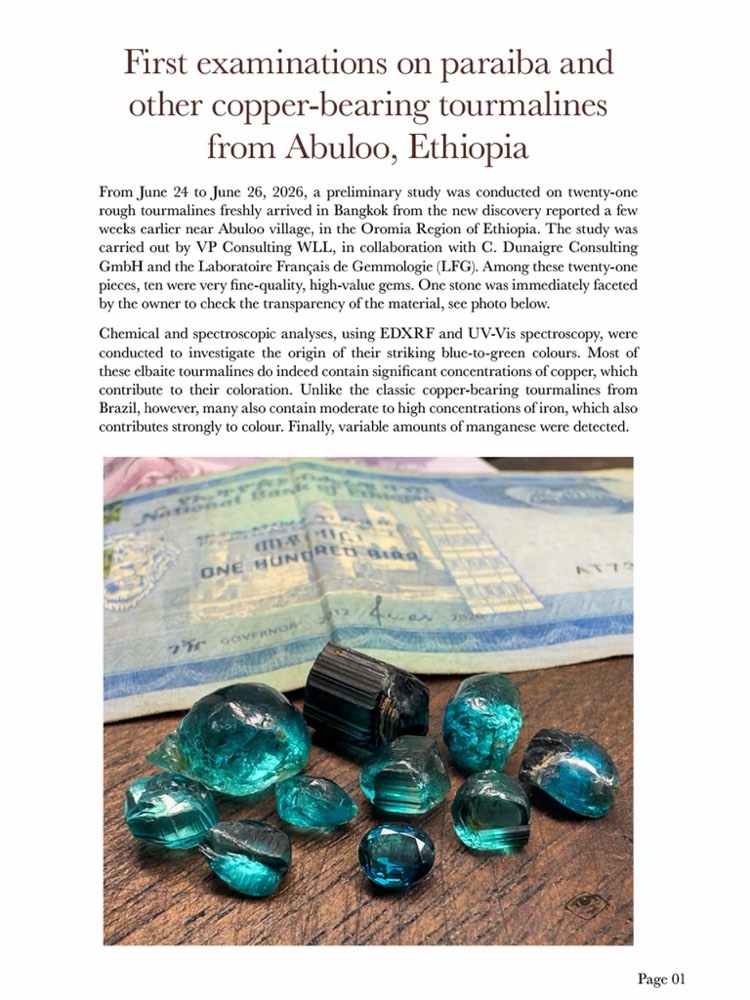
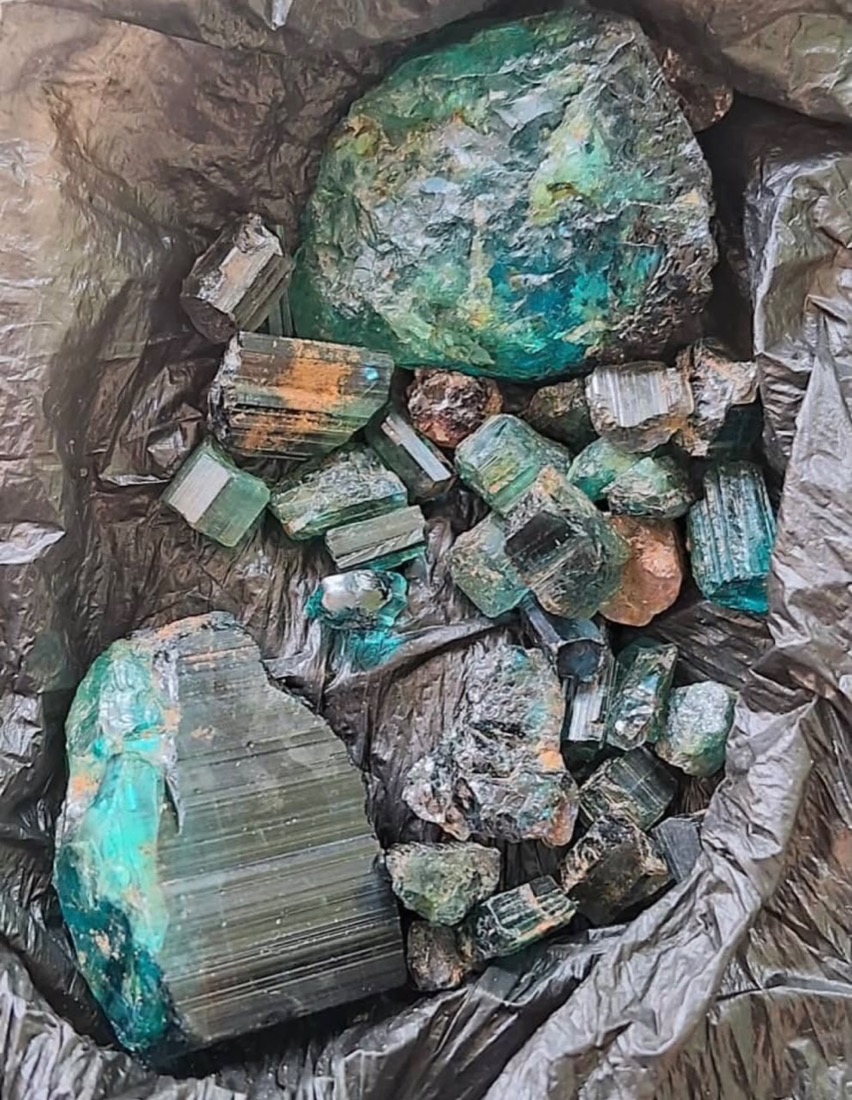
A landmark preliminary study conducted June 24–26, 2026, by VP Consulting and the Laboratoire Français de Gemmologie (LFG, Paris) confirmed the presence of copper-bearing elbaite tourmalines from Abuloo village in the Guji Zone of Ethiopia's Oromia Region, marking a newly documented Paraíba-type deposit.
Of 21 rough tourmalines examined, 10 were classified as very fine-quality, high-value gems. Their striking blue-to-green colour is driven by copper, the same chromophore responsible for the legendary Brazilian Paraíba tourmalines discovered in the late 1980s. These are stones from the exact region Ethiogemstone sources.
Who Conducted the Study
The study's authors are Vincent Pardieu (VP Consulting WLL), Christian Dunaigre and Aurelien Delaunay of the Laboratoire Français de Gemmologie (LFG, Paris), and Dr. Stefanos Karampelas of LFG and the University of Thessaloniki. Vincent Pardieu is widely known in the gemmological community for field expeditions documenting coloured-stone deposits worldwide; LFG is a Paris-based gemmological laboratory.
What Makes a Tourmaline "Paraíba"
The name Paraíba originally referred to a specific deposit in Paraíba State, Brazil, where copper-bearing elbaite tourmaline with an extraordinary neon blue-to-green colour was first found. Because the colour comes from copper (Cu), sometimes combined with manganese (Mn), gemmologists use "copper-bearing" or "Paraíba-type" to describe chemically and visually equivalent material found in other localities, including deposits later found in Nigeria and Mozambique. The Abuloo find places Ethiopia on that same short list.
Study Findings at a Glance
| Locality | Abuloo village, Guji Zone, Oromia Region, Ethiopia |
|---|---|
| Study Period | June 24–26, 2026 |
| Samples Examined | 21 rough tourmalines |
| High-Value Classification | 10 of 21 stones |
| Chromophore | Copper (Cu), with manganese (Mn) |
| Treatment Observed | Natural, untreated |
| Conducted By | VP Consulting WLL & Laboratoire Français de Gemmologie (LFG, Paris) |
This table reflects the preliminary study's stated findings and is not a certification of any individual stone. Individual gemstones are assessed and disclosed on their own merits at time of sale.
Why This Matters for Buyers
A newly confirmed Paraíba-type source is a rare event in the coloured gemstone trade — the last major confirmed sources were in Nigeria and Mozambique, decades after the original Brazilian discovery. For collectors and dealers, it means a new, traceable origin for material sharing the chemistry and visual character prized in Paraíba tourmaline, at a much earlier stage than most deposits are ever documented. We explain how "Paraíba-type" differs from the original Brazilian material, and why that distinction doesn't diminish the stone, in our companion guide: Paraíba-Type vs. Paraíba: What Every Buyer Must Know.
Ethiogemstone sources tourmaline directly from the Guji Zone, including material from this locality. See our full Ethiopian Tourmaline page, or view current stones on our Available Stones listing.